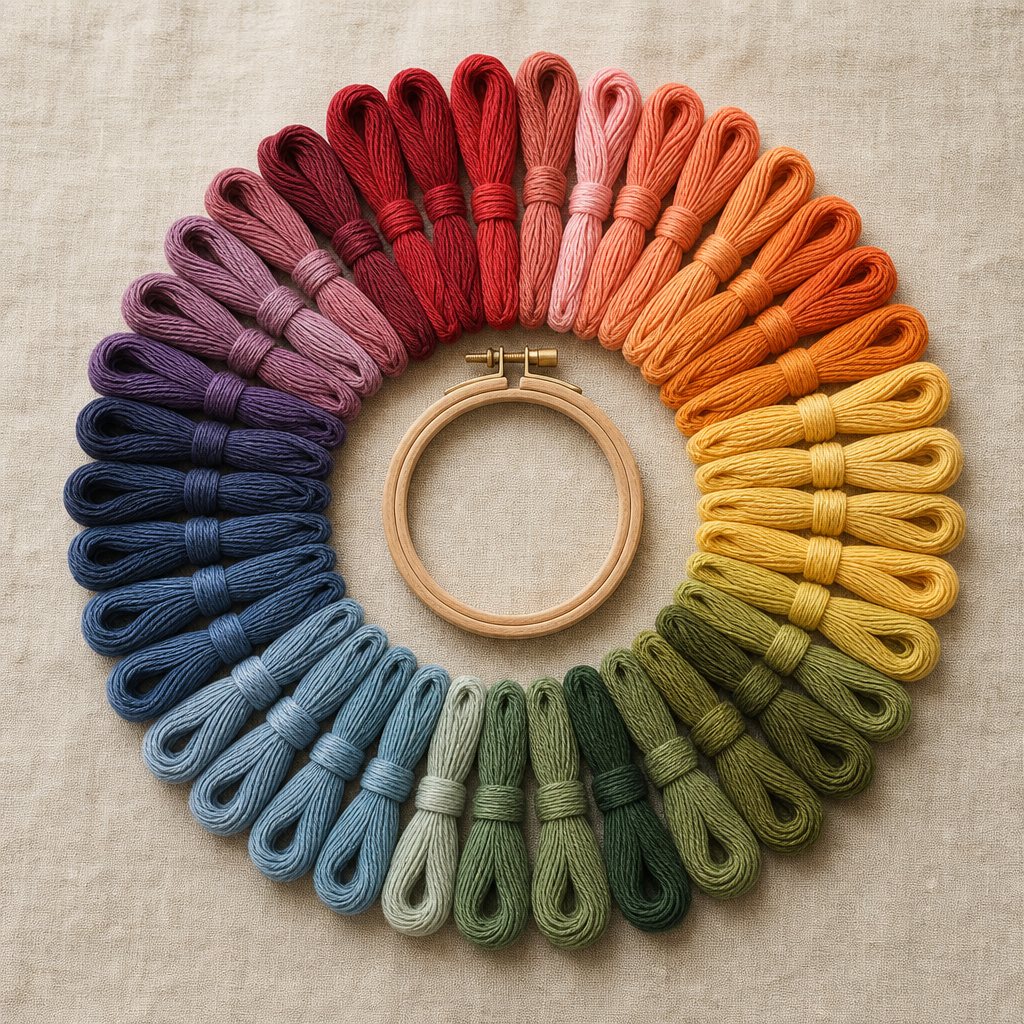
At the core of every cross stitch pattern maker is an essential algorithm: take each pixel's color and find the closest matching DMC embroidery thread.
While it might sound like a simple calculation, this matching step is where many digital pattern tools quietly ruin a design.
Most basic conversion tools calculate color distance using standard Euclidean RGB space—treating Red, Green, and Blue values as 3D coordinates and finding the shortest straight-line distance. While easy to program, RGB distance fundamentally misjudges how human eyes see color.
The fundamental flaw of RGB color distance
RGB color space was invented to describe how electronic monitors emit red, green, and phosphor light. It was never intended to represent human visual perception.
RGB color distance fails needlework in two major ways:
1. Channel Sensitivity Mismatch
Human retinas are packed with green-sensitive photoreceptors, but have far fewer blue receptors. In standard RGB calculations, red, green, and blue are treated with equal mathematical weight. As a result, an RGB algorithm treats a barely noticeable blue shift as equally significant to an obvious green shift, distorting foliage and sky gradients.
2. Hue vs. Lightness Confusion
In RGB space, moving from a mid-tone color toward a lighter shade can yield the exact same numerical distance as shifting into an entirely different hue.
In real-world embroidery, swapping a thread for a slightly lighter tone of the same family is almost imperceptible. But swapping a thread for the wrong hue—such as replacing warm beige skin with dull greenish-gray—creates unnatural, bruised patches across faces.
Why CIELAB (Lab) is superior for needlework
To solve the limitations of RGB, the International Commission on Illumination (CIE) developed the CIELAB (Lab) color space.
CIELAB maps colors along three perceptually scaled axes:
- L* — Perceptual lightness (from 0 = pure black to 100 = diffuse white).
- a* — The green-to-red color opponent axis.
- b* — The blue-to-yellow color opponent axis.
The critical advantage of CIELAB is perceptual uniformity: a numerical distance of 5 units anywhere in the Lab space represents approximately the same visible color difference to a human observer.
When StitchCraft matches pixel values to our 454 DMC cotton floss database, it converts both the source image and thread library into CIELAB space using Delta-E color distance formulas. "Closest match" finally means what looks most natural to your eyes, not just what looks similar to a computer monitor.
Where you notice the difference
The advantages of perceptual color matching are immediately visible in critical areas:
- Skin Tones: Lab matching preserves the subtle warm-to-cool hue progression across foreheads, cheeks, and chins, preventing the muddy or greenish discolourations typical of RGB tools.
- Natural Shadows: In RGB, deep dark tones are compressed, often causing rich navy or forest shadow depths to collapse into generic charcoal gray. Lab preserves subtle hue distinctions even in deep shadows.
- Botanicals & Foliage: Distinguishes warm golden-greens from cool emerald greens with realistic natural depth.
- Smooth Gradients: Transitions across skies and backdrops select an evenly spaced progression of DMC thread shades, avoiding harsh digital color banding.
The practical benefit: Cleaner charts with fewer skeins
Because CIELAB selects threads that truly harmonize with your image, you need fewer total colors to achieve stunning realism.
When a naive RGB algorithm continually picks slightly off-hue threads, the only workaround is adding more colors to fill the visual gaps. With accurate perceptual matching, a 24-color Lab-matched pattern frequently looks more cohesive and lifelike than a 36-color RGB chart.
That means fewer skeins to buy, a more compact symbol chart, and a significantly more relaxing stitching experience.