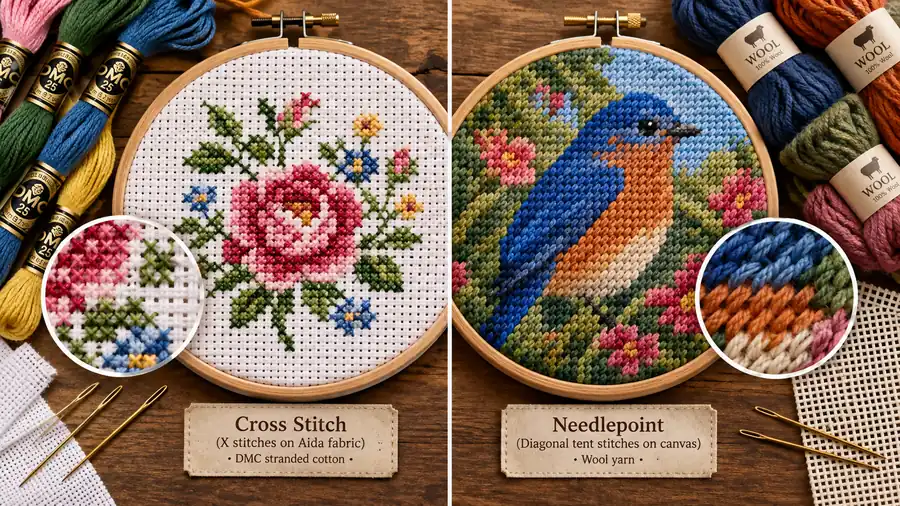
If you have ever wandered into a needlecraft store or scrolled through fiber arts forums, you have almost certainly encountered both cross stitch and needlepoint. At a quick glance from across a room, a framed piece of counted cross stitch and an ornamental needlepoint pillow might look remarkably similar: both feature vibrant pictorial designs constructed stitch-by-stitch on a grid.
However, once you look closer and pick up the needle, they are completely different crafts with distinct fabrics, fibers, stitch anatomies, and project workflows.
Understanding what is the difference between cross stitch and needlepoint will save you from buying the wrong supplies, help you choose the best craft for your creative goals, and reveal why modern digital charting tools are revolutionizing both worlds.
Quick Comparison: Cross Stitch vs. Needlepoint
Before diving into the technical details, here is a high-level comparison table summarizing the core differences:
| Feature | Counted Cross Stitch | Needlepoint (Canvas Work) |
|---|---|---|
| Primary Stitch | Two diagonal stitches forming an 'X' | Diagonal slant stitches (Tent, Basketweave, Continental) |
| Base Fabric | Pliable Aida cloth, evenweave, or linen | Stiff, heavily sized open-mesh mesh canvas (Mono, Penelope) |
| Background Coverage | Fabric background usually remains partially visible | The entire canvas must be 100% covered with stitches |
| Thread Type | Stranded cotton embroidery floss (e.g., 2 strands of DMC) | Thick tapestry wool, Persian wool, silk, or pearl cotton |
| Tension Frame | Round embroidery hoop or Q-Snap | Sturdy wooden stretcher bars or scroll frames (to prevent warping) |
| Average Cost | Budget-friendly ($5–$25 per project) | Higher end ($40–$150+ for hand-painted canvases & wool) |
| Finished Products | Framed wall art, bookmarks, ornaments | Durable cushions, upholstery, belts, sturdy heirloom items |
1. The Anatomy of the Stitch: The 'X' vs. The Diagonal Tent
The most fundamental distinction between the two crafts lies in the stitch itself.
Cross Stitch
In cross stitch, almost every single stitch is a full two-legged cross (X). You stitch one diagonal slant (/), and then cross over it with an opposite diagonal slant (\).
Because each 'X' is self-contained and symmetrical, cross stitch produces a pixel-like mosaic aesthetic. The holes of the fabric remain visible in unstitched areas, giving the finished work breathing room and texture.
Needlepoint
In traditional needlepoint, stitches do not cross over themselves into an 'X'. Instead, needlepoint relies on diagonal half-cross stitches—most commonly the Tent stitch family, including:
- Continental stitch: Stitched horizontally or vertically across canvas threads.
- Basketweave stitch: Stitched diagonally in a stepped rhythm that distributes yarn tension across both warp and weft, preventing the heavy canvas from pulling into a rhombus or trapezoid.
- Decorative specialty stitches: Mosaic stitch, Parisian stitch, Hungarian stitch, and brick stitch that create rich geometric textures.
2. The Fabric: Pliable Aida Cloth vs. Stiff Sized Canvas
Feel the two fabrics side by side, and the difference is unmistakable.
Aida & Evenweave Fabric (Cross Stitch)
Cross stitch uses pliable woven fabrics, most famously Aida cloth. Aida is woven from 100% cotton threads bundled together to form distinct squares with clear, open holes at each corner. Standard counts range from 14-count (14 stitches per inch) to 18-count.
Because Aida is soft and flexible, it easily clips into an inexpensive circular wooden hoop or lightweight Q-snap.
Needlepoint Canvas (Needlepoint)
Needlepoint is worked on a rigid, heavily starched open-mesh canvas made of single horizontal and vertical threads, known as Mono canvas (or double-mesh Penelope canvas). The canvas wires are stiff and scratchy like fine wire screening.
Because thick wool stitches pull with immense tension, needlepoint cannot be held in a circular hoop without severely denting the canvas. Instead, it must be stapled or taped onto square wooden stretcher bars to maintain rigid tension.
3. Thread & Floss: Stranded Cotton vs. Tapestry Wool
The choice of fiber dictates the final texture and durability of the finished craft.
- Cross Stitch uses Stranded Cotton: A standard skein of DMC embroidery floss contains six loosely twisted strands of mercerized cotton. Stitchers cut an 18-inch length and strip out only 2 (or 3) individual strands. This keeps the stitches delicate, lustrous, and smooth.
- Needlepoint uses Thick Tapestry Wool: Because the stiff canvas mesh has relatively large holes (usually 10 to 18 mesh counts) and the canvas must be completely hidden, needlepoint uses thick, non-divisible virgin wool (such as Appleton or DMC Tapestry Wool) or multi-ply Persian wool. The result is a thick, velvety pile capable of withstanding heavy daily use on dining chairs or throw pillows.
4. Total Canvas Coverage vs. Negative Space
A major visual difference is how each craft handles the background:
In cross stitch, you only stitch where the pattern calls for color. The blank fabric surrounding your subject serves as negative space. A delicate floral wreath or an inspirational quote might take up only 30% of the fabric area, leaving the rest of the crisp white or natural linen untouched.
In needlepoint, unstitched canvas is considered unfinished. Every square millimeter of the canvas must be completely covered with stitches—including the entire background. Stitched backgrounds often require solid blocks of basketweave stitch in cream, navy, or gold.
5. The Modern Design Shift: Hand-Painted Canvases vs. AI Charting
Traditionally, needlepoint kits are substantially more expensive than cross stitch kits because most high-end needlepoint designs are hand-painted directly onto the canvas by skilled artisans. A single 8×10 hand-painted canvas can cost $75 to $200 before purchasing wool.
Cross stitch, by contrast, has always been a counted medium: you look at a printed black-and-white or color-coded symbol grid and count your stitches onto blank cloth.
How StitchCraft Studio Bridges the Gap
Historically, creating your own custom counted chart took weeks of tedious manual graph paper plotting. Today, modern makers use StitchCraft Studio to generate professional-grade counted charts in seconds:
- Turn Personal Photos into Charts: Upload pet portraits, wedding photos, vacation landscapes, or custom illustrations.
- Intelligent DMC Floss Matching: StitchCraft matches every pixel against real-world DMC stranded cotton numbers in perceptual CIELAB color space, ensuring skin tones and delicate color gradients translate faithfully to thread.
- Smart Confetti Elimination: Eliminate messy single-pixel isolated stitches that make hand-stitching frustrating.
- Custom Fabric Sizing: Switch between 14-count, 16-count, or 18-count fabric profiles to see your exact finished dimensions and floss skein requirements before purchasing supplies.
Whether you prefer the delicate cross-hatch detail of cotton on Aida or the rich, textured warmth of wool on canvas, modern craft tools empower you to bypass overpriced commercial kits and make heirloom pieces that are uniquely yours.
Which One Should You Choose?
- Choose Cross Stitch if: You want an affordable, portable craft you can relax with on the couch, love delicate detail and photographic fidelity, and enjoy framing your finished artwork for the wall.
- Choose Needlepoint if: You love working with rich wool fibers, enjoy rhythmic background stitching, and want to create durable functional items like heirloom cushions, belts, or Christmas stockings.
Ready to start your next stitching project? Visit StitchCraft to convert any photo, digital art, or idea into an optimized cross stitch pattern with instant DMC color charts and free PDF downloads.