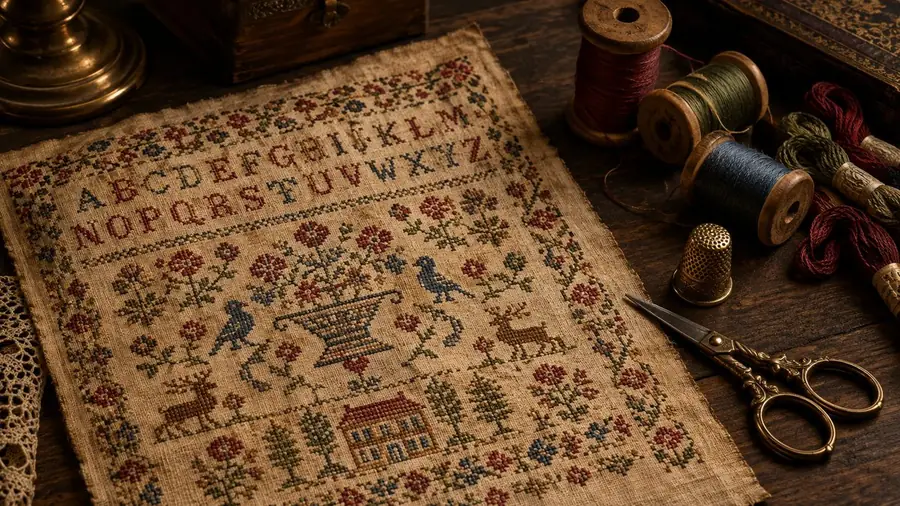
If you trace modern digital pixel art back through the centuries, you inevitably arrive at cross stitch. Long before computer screens divided imagery into pixels or RGB values, needleworkers understood that any visual idea—a family crest, a botanical rose, a scripture verse, or a landscape—could be broken down into discrete colored units on a grid.
When answering what is the history of cross stitch, one discovers a rich evolutionary story: a craft that began as structural reinforcement on ancient textiles, matured into a vital educational record for Renaissance women, sparked the first mass-market craft revolution in the Victorian era, and has now arrived at a sophisticated digital and AI renaissance.
1. Ancient Origins: The First Cross Stitches (Pre-1500)
Cross stitch is widely recognized as one of the oldest forms of embroidery known to humanity.
Archaeological excavations across the Mediterranean, Egypt, and Central Asia have uncovered cross-stitched fragments dating back thousands of years. Early garments from the Coptic period in Egypt (roughly 300–700 CE) reveal tunics adorned with cross-stitched bands in dyed linen and wool. In China, fragments dating to the Han Dynasty (206 BCE – 220 CE) and later Tang Dynasty silk pieces demonstrate counted-thread techniques used both to reinforce seams and to ornament garments.
In these early societies, cross stitch was essentially folk art and domestic utility:
- Folk Costumes: Across Eastern and Central Europe, counted cross stitch was central to national identity—exemplified by Ukrainian vyshyvanka, Romanian traditional blouses, and Hungarian folk sleeves. Red and black geometric motifs guarded against evil spirits and marked regional origins.
- Cultural Identity: In the Middle East, particularly Palestinian tatreez, distinct cross-stitched geometric motifs on thobes conveyed the wearer's village, marital status, and life milestones.
- Structural Integrity: Because the diagonal cross anchors both warp and weft threads simultaneously, it proved remarkably durable, outlasting fragile satin stitches or surface chain stitches on daily garments.
2. The Sampler Tradition: Living Stitch Libraries (16th–17th Century)
The defining chapter in the history of cross stitch arrived with the sampler.
The word sampler originates from the Latin exemplum, meaning an example or model to copy. Before the invention of inexpensive printing, books were luxurious rarities. Needlework patterns could not be purchased online or found in monthly magazines. When a stitcher encountered a rare decorative border, alphabet, or heraldic design, she stitched it onto a long strip of unbleached linen to create a permanent, physical reference library.
These early 16th and 17th-century pieces were known as band samplers:
- Long, narrow strips of linen (often 6 to 9 inches wide and up to a yard long), matching the narrow width of domestic looms.
- Densely packed with random bands of geometric lace, repeating borders, and alphabet letters.
- Rolled up and stored inside workbaskets like a personal reference manual.
The earliest dated surviving English sampler was stitched by Jane Bostocke in 1598 (now housed in London's Victoria and Albert Museum). It includes floral motifs, animals, an alphabet, and a commemoration of her cousin's birth—stitched with silk and metal threads on linen.
3. The 18th Century: Schoolgirl Education and Moral Samplers
By the 1700s, the purpose of the sampler fundamentally shifted from a private reference cloth to an instrument of female education.
In Europe and Colonial America, stitching a sampler became a mandatory rite of passage for young girls. It demonstrated:
- Literacy and Numeracy: Stitching the alphabet and numbers 1 through 10 proved the child could read and count.
- Domestic Readiness: Marking household linens (monogramming bedsheets, napkins, and undergarments with cross-stitched initials) was essential for inventory control in domestic management.
- Moral & Religious Devotion: Samplers began featuring pious verses, poems about mortality, and renderings of local churches or family homes.
These "pictorial samplers" were rectangular, framed with decorative borders, signed with the child's name and age (often as young as six or eight), and proudly hung in the family parlor as tangible proof of a daughter's virtue and skill.
4. The 19th Century: Berlin Wool Work and the First Craft Democratization
During the 19th century, the Industrial Revolution transformed cross stitch from an aristocratic skill into a global mass-market phenomenon through Berlin Wool Work.
In 1804, a Berlin print-seller named Phillipson began publishing needlework patterns printed on gridded paper. Artists hand-colored each tiny square with watercolors, creating the direct ancestor of modern cross stitch charts:
- No Counting Guesswork: Instead of laboriously copying from another textile or measuring linen threads with magnifying glasses, a stitcher simply matched thread colors to the colored squares on the paper chart.
- Vivid Synthetic Dyes: In 1856, William Henry Perkin accidentally discovered mauveine, the first synthetic aniline dye. Suddenly, brilliant magenta, emerald green, and cobalt blue wools (known as "Berlin wool") flooded parlor rooms worldwide.
- Standardized Cotton Thread: During this same period, Dollfus-Mieg & Compagnie (founded in 1746 in Mulhouse, France) perfected mercerized cotton stranded floss under the brand DMC. Their numbered shade system provided consistent, colorfast hues that remain the undisputed world standard to this day.
Victorian households covered slippers, fire screens, bell pulls, and parlor stools in dense, jewel-toned cross stitch.
5. The 20th Century: Aida Cloth and the Modern Counted Craze
In 1907, the German textile manufacturer Zweigart introduced a revolutionary fabric: Aida cloth.
Woven specifically for counted embroidery, Aida groups warp and weft yarns into distinct four-thread clusters separated by visible holes. This eliminated the eye strain of counting uneven linen threads. Stitches were guaranteed to be perfectly square and uniform.
With Aida cloth and DMC floss readily accessible, the mid-to-late 20th century saw the explosion of counted cross stitch:
- The 1970s and 1980s: Craft guilds, pattern books, and pre-packaged kits dominated home crafting.
- The 1990s & 2000s: The emergence of "subversive cross stitch." Contemporary crafters turned the traditionally demure Victorian medium on its head, pairing classic botanical borders with wry humor, feminist statements, and pop-culture motifs.
6. The 21st Century: The Digital & AI Renaissance
Today, cross stitch is experiencing its most exciting transformation since the invention of the printed chart in 1804.
Consider the relationship between a cross stitch chart and digital graphics:
- A cross stitch chart is a two-dimensional grid of coordinates.
- Each square represents a single color.
- Each stitch is a physical pixel rendered in twisted cotton thread.
The digital era first brought pixel art and digital chart-editing software. But the newest frontier is AI-driven pattern creation.
For centuries, converting a real-world portrait, beloved pet photograph, or original artwork into a stitchable chart was an arduous craft that took weeks:
- Colors had to be manually matched against physical thread cards.
- Intricate gradients had to be simplified by hand to avoid unbearable "confetti" stitches.
- Stitch counts and fabric sizes had to be calculated on scratch paper.
Modern tools like StitchCraft have digitized this centuries-old tradition:
- Perceptual Color Science: Rather than naive digital approximations, modern generators calculate color distance in CIELAB space, finding the closest perceptual match among hundreds of DMC floss shades.
- AI Confetti Reduction & Smoothing: AI algorithms intelligently analyze photographic contours, clustering stray pixels into coherent thread shapes so your needlework remains enjoyable and rhythmic.
- Custom Modern Samplers: Stitchers today can generate custom family heirlooms, pet portraits, or modern illustrations with the click of a button—then export print-ready PDF symbol charts in seconds.
A Timeless Craft Across Millennia
| Era | Key Milestones | Defining Materials |
|---|---|---|
| Ancient (Pre-1500) | Folk tunics, burial bands, protective folk embroidery | Linen, wool, silk |
| Renaissance (1500–1700) | Band samplers, personal stitch reference libraries | Hand-loomed linen, silk floss |
| 18th Century | Schoolgirl pictorial samplers, alphabets, moral verses | Fine linen, counted thread |
| 19th Century | Berlin wool work, colored gridded charts, DMC thread | Aniline-dyed wool, gridded paper |
| 20th Century | Zweigart Aida cloth (1907), subversive cross stitch | Aida fabric, 6-strand cotton floss |
| 21st Century (Today) | Digital pixel craft, AI photo-to-pattern generation | Digital PDF charts, DMC cotton |
What makes cross stitch so enduring is that, despite all the technological shifts around it—from hand-spun linen to printed paper to AI algorithms—the fundamental tactile joy has never changed: one needle, a length of thread, and the meditative satisfaction of making one clean cross at a time.
Step into the next chapter of cross stitch history. Use StitchCraft to design your own custom heirlooms, portraits, or modern samplers with AI-assisted chart generation and instant DMC color keys.